
Trump told reporters this month, “whoever wins AI wins.”
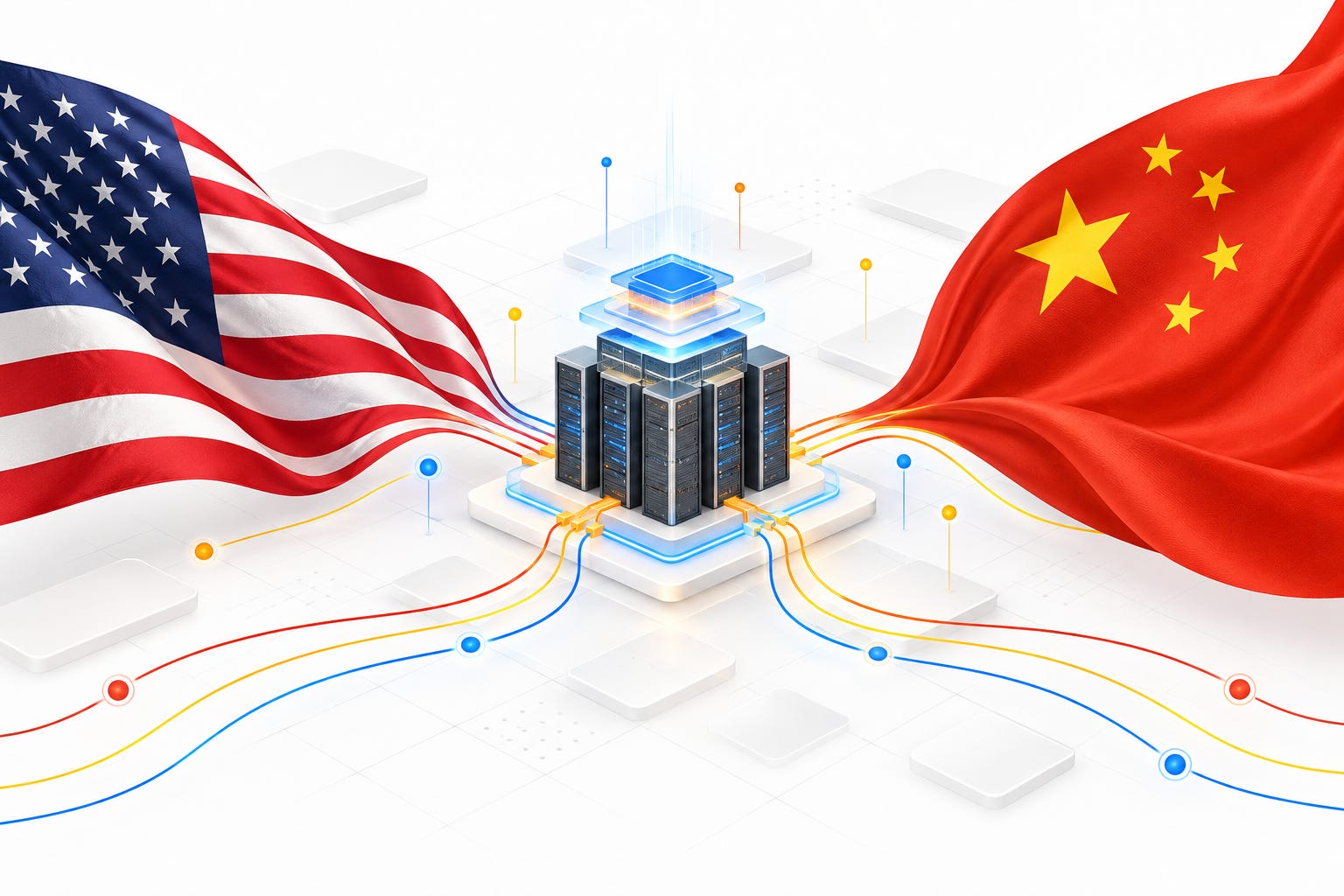
He’s right that it matters. He’s probably wrong about what winning looks like.
The scoreboard everyone watches shows model releases and benchmark scores. The one underneath it is measured in gigawatts. Here’s the number that should stop you cold.
The US has more data centre capacity than the next fourteen countries combined.
The dataset behind that claim counted 32 gigawatts operating in the United States, with enough under construction or planned to push the total beyond 102 gigawatts.
That second number needs a warning label. Pipeline is not production. Some projects will arrive late and some will never receive the grid connection, financing, or permits they need. Goldman Sachs expects only 50% to 60% of scheduled US capacity to land on time over the next two years.
But the operational number has already moved in America’s direction. Cushman & Wakefield’s September update puts operational capacity across the Americas at 50.3 GW, with 94.1% of it in the United States. That works out to roughly 47 GW already running.
The lead is real. It just should not be confused with a guarantee.
China sits second and isn’t close on data-centre capacity. Here’s what makes this interesting rather than a victory lap: China can genuinely build physical infrastructure faster and cheaper than almost anyone alive. Its industrial machine is a structural advantage, not a talking point.
So if China can out-build us, why is this piece titled the way it is?
Because two races are running at once, and almost everybody is watching only one of them.
The Race Has Two Halves
Start with what those gigawatts measure, because precision matters here. They describe power capacity available to data centres. They do not tell you which chips are inside, what percentage of the workload is AI, how efficiently the facility operates, or whether the planned power has even been energized.
Gigawatts are an input. Useful compute is the next layer.
China’s side deserves to be taken seriously.
Its build speed is real. China added 38.4 GW of thermal power capacity in the first half of 2026, up 49% year over year, and 13.6 GW of wind capacity in June alone, a record for the month. Those are the numbers of a country that can pour industrial capacity at a problem faster than almost anyone.
Its cost position is real too, although the clean “three cents versus nine cents” comparison you sometimes see is too simple. Select Chinese facilities can secure extremely cheap long-term power, but delivered costs vary by province, capacity charges, reliability requirements, and contract structure. The direction of the advantage is clear. The exact percentage is not.
And its supply chain is real. China leads the world in installed capacity for coal, hydro, wind, and solar. It manufactures much of the transformer, cooling, battery, and grid equipment the rest of the world imports.
If the AI race were only a construction contest, China would be terrifying. It isn’t only a construction contest.
Where China’s advantage narrows
China cannot currently make frontier AI chips at the quality and volume available to American companies. SMIC can produce advanced chips through expensive multi-patterning on deep-ultraviolet equipment, but export controls deny it the extreme-ultraviolet tools and other inputs that make leading-edge production economical at scale.
One comparison of Nvidia and Huawei’s public roadmaps puts Nvidia’s top chip at roughly five times Huawei’s total processing performance today, with the projected gap widening by 2027. That is a roadmap comparison, not destiny, but it identifies the chokepoint correctly: cheap buildings and cheap electricity do not become frontier compute without accelerators, high-bandwidth memory, networking, and software.
Three-cent electricity in a building with no useful hardware is a very efficient way to run nothing.
Utilization matters too. Some state-directed Chinese clusters have historically run below capacity. But this is where Americans should resist getting smug. US developers also reserve multiple sites, chase the friendliest grid connection, and abandon projects that stop pencilling out. Empty capacity does not compound in either system.
China’s governance creates another tension. Beijing wants AI powerful enough to transform its economy and controllable enough never to threaten the Party. Its standards emphasize security, circuit breakers, and emergency control. That may slow open experimentation. It may also accelerate deployment in areas the state chooses to prioritize. Nobody should pretend that question is settled.
Which brings us to the actual point: compute is an ingredient, not the prize.
What compounding actually means
A gigawatt is a number. A gigawatt feeding a population that can turn it into useful systems is a flywheel.
America’s advantage is not just electricity. It is the combination of hyperscale cloud infrastructure, private capital, frontier chip access, deep software talent, universities, and businesses willing to pay for new tools. Capacity becomes products. Products drive adoption. Adoption attracts talent and capital. Talent and capital justify the next round of capacity.
That is the compounding lead.
But it is not automatic, and China is not “skipping” the conversion layer. China leads the world in industrial robot installations, produces enormous volumes of AI research, and has built models close to the American frontier despite its hardware constraints. It may convert AI into factories, logistics, EVs, drones, and low-cost inference faster than the US converts it into broad productivity.
So the honest American case is narrower and stronger: the US owns the best starting position. It owns more operational capacity, better access to frontier accelerators, deeper cloud distribution, and dramatically more private AI investment. If American operators turn that access into working systems, the lead compounds. If they treat it as a spectator sport, it doesn’t.
There is also a dependency hiding inside the phrase “American chips.” Nvidia designs them in the United States. TSMC fabricates most of the leading ones in Taiwan. America’s lead is real, but its hardware foundation is an allied supply chain, not an island.
The US power buildout carries the same caveat. Developers planned a record 86 GW of new utility-scale generation for 2026, if realized. More than a quarter of that plan was battery storage, and planned nameplate capacity is not the same thing as round-the-clock energy delivered to a data centre.
The lead is real, and it isn’t guaranteed. That distinction is the whole point.
How To Read The AI Race Without Getting Fooled
Here’s the problem with everything you just read: you’ll forget it by Tuesday.
Not because you’re careless. Because the news cycle will flood you with a hundred stories written to one scoreboard. Model launches. Benchmark charts. One executive’s quote. One pundit’s certainty. You’ll be told the race is over, then that it never existed, then that it’s already lost.
Five habits fix that.
1. Track energized compute, not announced ambition
A benchmark tells you what a model can do in a test. A planned gigawatt tells you what someone hopes to build. Neither is enough by itself.
Track what is operating, which accelerators are inside it, how much power is actually available, and whether customers are using it. Concrete is harder to fake than a press release, but an energized rack is harder to fake than a pipeline chart.
2. Separate the physical race from the applied race
Every AI claim is partly about the ability to build capacity and partly about the ability to use it. Confusion begins when someone answers one question while pretending to answer the other.
China can lead in industrial construction while America leads in frontier compute. China can trail in chips while leading in a deployment category. Hold both ideas at once and most of the noise disappears.
3. Watch the chokepoints
Factory count is ambition. Accelerator supply is capability. Grid connection is availability. High-bandwidth memory, advanced packaging, transformers, networking, and cooling can each stop a project that looks inevitable on a slide.
And remember where those chokepoints live. The American AI stack crosses Taiwan, the Netherlands, South Korea, Japan, and allied supply chains before a model ever reaches a US data centre.
4. Watch adoption by sector
Building 100 gigawatts does nothing if businesses fail to put the compute to work.
Watch how quickly small businesses automate real operations. Watch whether factories improve throughput. Watch whether agencies ship internal tools. Watch whether people stop treating models as novelty chatbots and start giving agents named jobs with measurable outcomes.
5. Ask what compounds
A new data centre is a number. A data centre full of companies shipping useful products is a loop. A chip announcement is a number. A chip that unlocks a thousand developers is a loop.
The country with the strongest flywheel wins more often than the country with the loudest launch.
What This Means For You
The compounding lead is not something you watch from the stands. It is made out of individual decisions.
Every agency owner who automates intake. Every freelancer who turns one hour into ten. Every operator who gives repetitive work to an agent and keeps judgment, taste, and relationships for themselves.
You are a tooth on the gear, not a spectator to it.
So here is the question worth sitting with: if the physical race is measured in gigawatts and the applied race is measured in what people do with them, what would change if you treated your own AI adoption as infrastructure this quarter?
Build Your Own Conversion Layer
Nationally, the conversion layer turns power into productivity. Inside your business, it turns access to AI into clients, content, and delivery systems you do not have to babysit.
That is what we are building inside the Agentic Business Sprint: four workshops sequenced over eight weeks to install both ends of an agentic business—client acquisition and delivery—plus twelve weeks of direct access to me while the systems run.
By the end, you will own an offer that converts, an outreach engine running daily, a founder-led content system, and three agents doing named jobs in your business.
The founding round starts September 28, 2026. It is capped at 20 seats and priced at $997—the lowest this program will be offered.
See the full eight-week build and claim a founding seat →
I write about AI geopolitics, the compute buildout, and the practical side of using all of this before it uses you. Explore more at Brian Decoded.
Sources
Computer Weekly: global operational and pipeline data-centre capacity
Cushman & Wakefield: Americas Data Center Update, September 2026
Goldman Sachs Research: US data-centre capacity and delay forecasts
US Energy Information Administration: planned 2026 generation additions
International Energy Agency: data-centre workloads and electricity demand
Council on Foreign Relations: Nvidia and Huawei roadmap comparison
Stanford AI Index 2026: models, research, adoption, robotics, and hardware supply chains
The “compounding lead” is my framework, not a measured quantity. Pipeline figures are forward-looking and vary by tracker. The argument is that America has the strongest starting position—not that infrastructure converts itself into outcomes.